We use our own and third-party cookies to analyse our services and show you advertising related to your preferences based on a profile of your browsing habits (e.g. pages visited). You can get more information and configure your preferences HERE.
Necessary cookies
Always active
These cookies are strictly necessary for the site to function. You can deactivate them by changing your browser settings, but you will not be able to use the site normally.
Cookies used
Functional cookies
These cookies provide the information necessary for the applications on the site itself or integrated by third parties. If you deactivate them, you may encounter problems in the operation of the page.
Cookies used
The user is informed that he/she has the possibility of configuring his/her browser so that he/she is informed of the reception of cookies, and may, if he/she so wishes, prevent them from being installed on his/her hard drive.
Below we provide the links of various browsers, through which you can make this configuration:
The quality of an Iberian ham does not depend only on the length of its curing. It starts much earlier: with the breed of the pig, its diet, its life in the dehesa and a slow, carefully controlled production process. Understanding how a good Iberian ham is made and matured helps you choose better, identify the different categories and keep the ham in the best possible condition once opened.
Iberian ham production: quality starts long before the cellar
The production of a quality Iberian ham begins long before the ham enters the ageing cellar. In the world of Iberian products, the final result depends largely on the origin of the animal, its percentage of Iberian breed, its diet and the way it has been raised.
For acorn-fed Iberian hams, the most important fattening period takes place in the dehesa. During the montanera season, Iberian pigs roam freely and feed on acorns, grass and other natural resources. This stage has a direct influence on the fat infiltration, the texture of the meat and the final flavour of the ham.
Then comes the actual production of the ham: salting, washing, resting, drying and ageing. In high-quality Iberian hams, especially those from prestigious areas such as Jabugo, each stage is slow and carefully controlled. The goal is not to speed things up, but to allow the ham to lose moisture gradually, for the salt to balance naturally and for the aromas to develop over time.
This is why curing alone cannot work miracles. A good ageing process can refine and enhance an exceptional piece, but it cannot turn an average raw material into a great ham. The real quality of an Iberian ham begins in the field.
Iberian ham curing: how long does a good ham need?
Curing Iberian ham requires patience. Spanish regulations set minimum production times for Iberian hams, but the most demanding producers usually work with much longer ageing periods, especially for acorn-fed hams and larger pieces.
In a high-end Iberian ham, maturation can last for several years. During this time, the ham slowly loses moisture, its flavour becomes more concentrated and its texture gains complexity. The infiltrated fat also evolves, becoming softer and more aromatic, which helps create the smooth, lingering mouthfeel that makes Iberian ham so distinctive.
One thing is important to remember: more time does not automatically mean better quality, but a great Iberian ham needs time. The curing process must be slow, balanced and adapted to each individual piece.
How to recognise a quality Iberian ham
To recognise a quality Iberian ham, the first thing to check is the official colour seal or tag attached to the piece. In Spain, Iberian hams are identified by a colour system that makes it easier to understand the product category.
The black seal corresponds to 100% Iberian bellota ham, the highest category and the only one that can strictly be called Pata Negra. The red seal identifies acorn-fed Iberian hams from 50% or 75% Iberian pigs. The green seal corresponds to cebo de campo Iberian ham, while the white seal is used for cebo Iberian ham.
Summary table of Iberian ham colour seals
Seal colour
Category
Iberian breed
Diet and rearing
Black
100% Iberian bellota ham
100% Iberian
Fed on acorns in the dehesa during the montanera. This is the category known as Pata Negra.
Red
Iberian bellota ham
50% or 75% Iberian
Fed on acorns in the dehesa during the montanera
Green
Cebo de campo Iberian ham
50%, 75% or 100% Iberian
Outdoor or extensive rearing, with a mixed diet
White
Cebo Iberian ham
50%, 75% or 100% Iberian
Farm-reared, fed mainly on cereals and feed
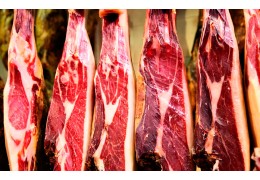
Beyond the colour seal, it is also worth looking at the appearance of the ham. A good Iberian ham usually has visible fat infiltration, a glossy texture, an intense aroma and a supple feel. The fat should be soft and melt easily, not dry or hard. The sales description should also be clear and complete. In a quality product, information about breed, diet and category should always be easy to understand.
How to store Iberian ham after opening
Storing Iberian ham correctly is essential if you want to preserve its texture and flavour. Once the ham has been started, it should be kept in a cool, dry and well-ventilated place, away from heat sources and direct sunlight.
After slicing, it is best to cover the cut surface with a thin layer of white fat taken from the ham itself. This helps protect the surface and reduce oxidation. You can also cover the piece with a clean cotton cloth, while avoiding airtight wrapping for long periods, as the ham needs to breathe.
If the ham is already sliced and vacuum-packed, it should be stored in the refrigerator. Before serving, take it out in advance so it can return gradually to room temperature. Iberian ham served too cold loses aroma, and the fat does not melt properly, which makes the tasting experience much less enjoyable.
Conclusion
The quality of an Iberian ham does not depend on one single factor. It is the result of a complete chain: Iberian breed, diet, type of rearing, careful production and slow curing. That is why choosing well means looking beyond the name. You need to check the seal, read the category, observe the piece and know how to store it once opened. This is what makes the difference between an ordinary ham and a truly high-quality Iberian ham.